
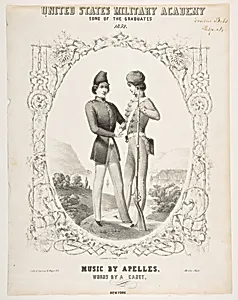
United States Military Academy: Song of the Graduates
Medium
Lithograph printed in black ink on cream wove paper
Dimensions
sheet: 13 1/16 x 10 1/16 in. (33.2 x 25.6 cm)
Classification
Prints
Department
Drawings and Prints
Museum
Metropolitan Museum of Art, New York, NY
Credit
Gift of Paul F. Walter, 1985
Accession Number
1985.1161.17
Rights
Public Domain
Tags
Art Historical Context
In 1852, James McNeill Whistler, a young cadet at the United States Military Academy at West Point, with the lithographic firm Sarony & to create *United States Military Academy: Song of the Graduates*. This black-ink lithograph on cream wove paper (13 1/16 x 10 1/16 in.) captures the of military camaraderie, likely as an illustrative cover for sheet music celebrating West Point graduates. Whistler, who attended the academy from 1851 1854 before pursuing art in earnest, infused the print with scenes of uniformed men and firearms, evoking pride in American military tradition amid rising national tensions leading to the Civil War. Lithography, a planar printing technique popular in the mid-19th century, allowed for detailed, reproducible images ideal for music sheets and ephemera. Whistler's early involvement here foreshadows his later mastery of printmaking and his shift toward Aestheticism, though this work reflects a more straightforward, illustrative style suited to its patriotic purpose. Housed in the Metropolitan Museum of Art's Drawings and Prints department (gift of Paul F. Walter, 1985), it offers a rare glimpse into Whistler's formative years and the cultural veneration of West Point as a cradle of leadership.
About the Artist
James McNeill Whistler|Sarony & Major · 1834–1903
James Abbott McNeill Whistler (1834-1903) was an American-born painter and printmaker who became a leading figure in the Aesthetic Movement and pioneer of Tonalism and Japonisme. He revolutionized art by championing "art for art's sake" and treating paintings as visual equivalents of musical compositions, titling works as "arrangements," "harmonies," and "nocturnes" to emphasize formal qualities o...