
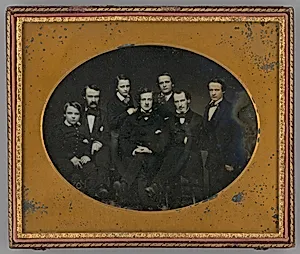
Untitled (Gregory Brothers)
Medium
Daguerreotype
Dimensions
15.2 × 18.5 cm (6 × 7 5/16 in.); Case, no cover: 16.5 × 19.7 × 1.4 cm (6 1/2 × 7 13/16 × 9/16 in.); Plate: 15.3 × 18.5 cm (6 × 7 1/4 in.)
Classification
portrait
Department
Photography and Media
Museum
Art Institute of Chicago
Accession Number
249982
Rights
Public Domain
Art Historical Context
This striking daguerreotype portrait, created by Alexander Beckers in 1849, captures the Gregory Brothers in remarkable detail. As one of the earliest photographic processes, the daguerreotype—introduced just a decade earlier by Louis Daguerre—produced a direct positive image on a silver-plated copper sheet, yielding an extraordinary level of clarity and depth that fascinated viewers of the time. In the mid-nineteenth century, such portraits marked a revolutionary shift in how people preserved likenesses. Unlike painted miniatures, which required weeks of sittings, daguerreotypes offered a faster, more affordable way to document family members. The medium’s mirror-like surface and precise rendering made each image feel both intimate and lifelike, reflecting photography’s emerging role as a new artistic and documentary tool. Housed in its original case, this work exemplifies the intimate scale and protective presentation typical of early photographic portraits. Today it stands as a valuable record of both the Gregory family and the dawn of photographic media, inviting us to consider how technology transformed personal memory and visual culture.