
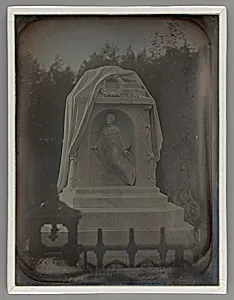
Untitled (Mt. Auburn Cemetery, Cambridge, MA)
Medium
Daguerreotype
Dimensions
21.6 × 16.5 cm (8 9/16 × 6 1/2 in.); Frame: 21.7 × 16.5 × 0.4 cm (8 9/16 × 6 1/2 × 3/16 in.); Plate: 21.6 × 16.6 cm (8 1/2 × 6 1/2 in.)
Classification
portrait
Department
Photography and Media
Museum
Art Institute of Chicago
Accession Number
250200
Rights
Public Domain
Art Historical Context
This striking daguerreotype from 1850 captures a tranquil view within Mt. Auburn Cemetery in Cambridge, Massachusetts, one of America’s earliest garden cemeteries. Created by the celebrated Boston partnership of Albert Sands Southworth and Josiah Johnson Hawes, the work exemplifies the early years of photography when the medium was still a remarkable novelty. Their studio became renowned for producing exceptionally detailed and luminous images that elevated photography to an art form. Daguerreotypes like this one required long exposure times and meticulous chemical processes on silver-plated copper, resulting in unique, mirror-like positives. The classification as a portrait may reflect the era’s interest in situating figures or memorials within evocative landscapes, inviting viewers to reflect on memory and place. Mt. Auburn itself was designed as a peaceful, park-like setting for contemplation, aligning with the romantic sensibilities the time. As one of the Art Institute of Chicago’s treasures in photography and media, this image offers a rare glimpse into mid-nineteenth-century American visual culture. Southworth & Hawes’s technical mastery and artistic vision helped establish photography’s enduring role in preserving both personal and public history.