
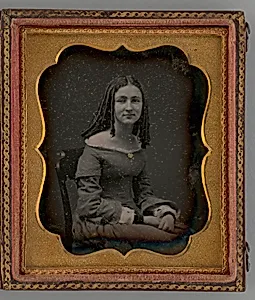
Untitled (Portrait of a Girl)
1856
Medium
Daguerreotype
Dimensions
8.2 × 6.8 cm (3 1/4 × 2 11/16 in.); Open case: 9.2 × 16 × 1.2 cm (3 5/8 × 6 5/16 × 1/2 in.); Case: 9.2 × 8 × 1.5 cm (3 5/8 × 3 3/16 × 5/8 in.); Plate: 8.3 × 7 cm (3 1/4 × 2 3/4 in.)
Classification
portrait
Department
Photography and Media
Museum
Art Institute of Chicago
Accession Number
249914
Rights
Public Domain
Art Historical Context
This daguerreotype portrait, created in 1856 by an unknown maker, exemplifies the earliest era of photography. Invented by Louis Daguerre in 1839, the process used a silver-plated copper sheet to produce a single, highly detailed positive image. Popular through the 1850s daguerreotypes offered unprecedented sharpness and realism, allowing middle-class families to commission affordable likenesses previously limited to painted miniatures. The work’s protective case, with its hinged design and velvet lining, underscores how these fragile objects were treated as precious keepsakes. The young girl’s direct gaze and composed posture reflect the technical demands of the medium, which required sitters to remain still for several seconds. Despite the unknown photographer, the portrait conveys a quiet intimacy typical of mid-nineteenth-century American photography. Its modest scale invites close viewing, preserving a personal moment from a time when photography was rapidly reshaping how people recorded and remembered their loved ones. Now part of the Art Institute of Chicago’s collection in the Department of Photography and Media, this piece illustrates the medium’s shift from novelty to cultural staple, bridging art and everyday life in the Victorian age.