
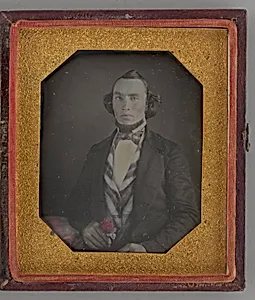
Untitled (Portrait of a Man)
1845
Medium
Daguerreotype
Dimensions
8.1 × 7 cm (3 1/4 × 2 13/16 in.); Open case: 16 × 9.3 × 1.1 cm (6 5/16 × 3 11/16 × 7/16 in.); Case: 8 × 9.3 × 1.7 cm (3 3/16 × 3 11/16 × 11/16 in.); Plate: 8.3 × 7 cm (3 1/4 × 2 3/4 in.)
Classification
portrait
Department
Photography and Media
Museum
Art Institute of Chicago
Accession Number
249913
Rights
Public Domain
Art Historical Context
Step into the dawn of photography with *Untitled (Portrait of a)*, a captivating daguerreotype from 5 created by an unknown maker. This intimate portrait captures a solemn gentleman gazing directly at the viewer, housed in a protective case typical of the era. Measuring just 8.1 × 7 cm, the tiny plate—smaller than a modern smartphone screen—reveals the medium's delicate scale, often treasured like fine jewelry. Daguerre, introduced in 1839, marked a revolutionary leap from painted portraits, making lifelike images accessible to the middle class for the first time. Produced on silvered copper plates treated with chemicals and exposed for minutes in bright light, each image is a unique positive, shimmering with a mirror-like sheen that demands careful viewing from the right angle. By 1845, studios across Europe and America buzzed with sitters enduring stiff poses to avoid blurring, preserving personal legacies in unprecedented detail. Held in the Art Institute of Chicago's Photography and Media Department, this anonymous work exemplifies early portraiture's cultural shift: photography wasn't just art but a mirror to 19th-century identity, blending science and portrait tradition in a single, irreplaceable gleam.