
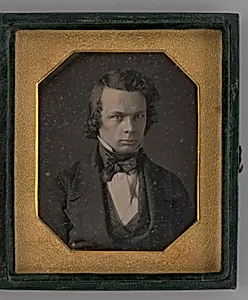
Untitled (Portrait of a Man)
1846
Medium
Daguerreotype
Dimensions
8.2 × 6.9 cm (3 1/4 × 2 3/4 in.); Open case: 9.2 × 15.8 × 1 cm (3 5/8 × 6 1/4 × 7/16 in.); Case: 9.2 × 7.9 × 1.7 cm (3 5/8 × 3 1/8 × 11/16 in.); Plate: 8.3 × 7 cm (3 1/4 × 2 3/4 in.)
Classification
portrait
Department
Photography and Media
Museum
Art Institute of Chicago
Accession Number
249917
Rights
Public Domain
Art Historical Context
Step into the nascent world of photography with *Untitled (Portrait of a)*, a daguerre created in 1846 by an unknown maker. This intimate captures a solemn male subject in exquisite detail, housed in a protective case typical of the era. Measuring just 8.2 × 6.9 cm, the plate's diminutive made it portable and affordable, revolutionizing personal portraiture for the middle class. The daguerreotype process, patented by Louis Daguerre in 1839 popularized worldwide by the 1840s, produced-of-a-kind images on silvered copper plates. Exposed to mercury vapor and chemically fixed, these mirror-like positives required steady lighting and long exposures—often minutes—demanding subjects remain perfectly still. This technical marvel marked photography's shift from novelty to art, preserving fleeting moments with unprecedented realism before paper prints dominated. Held in the Art Institute of Chicago's Photography and Media Department, this artifact embodies 19th-century innovation and cultural fascination with self-representation. Gaze into the eyes of an anonymous sitter, and you'll witness history's first "photos," bridging painting's tradition with modernity's gaze.