
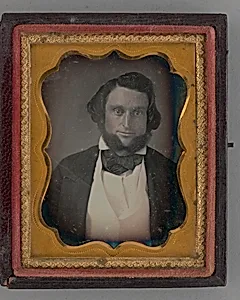
Untitled (Portrait of a Man)
1856
Medium
Daguerreotype
Dimensions
6.3 × 5 cm (2 1/2 × 2 in.); Open case: 7.3 × 12.2 × 1.1 cm (2 7/8 × 4 13/16 × 7/16 in.); Case: 7.3 × 6.1 × 1.6 cm (2 7/8 × 2 7/16 × 11/16 in.); Plate: 6.4 × 5.1 cm (2 1/2 × 2 in.)
Classification
portrait
Department
Photography and Media
Museum
Art Institute of Chicago
Accession Number
249936
Rights
Public Domain
Art Historical Context
This intimate *Untitled (Portrait of a Man, created in 1856 by an unknown maker, captures the stoic gaze of its subject through the pioneering medium of daguerreotype. Measuring just 6.3 × 5 cm on its silvered copper plate, this tiny portrait was housed in a protective case—typical for the era, transforming it into a cherished personal keepsake, much like a locket oroch. Patrons at the Art Institute of Chicago's Photography and Media department can appreciate its mirror-like sheen, a hallmark of daguerreotypes that produced strikingly detailed, one-of-a-kind images without negatives. Invented by Louis Daguerre in 1839, the daguerreotype process dominated portraiture through the 1850s, offering unprecedented realism to the growing middle class. By 1856, however, it was yielding to faster, reproducible methods like the wet-collodion plate. The sitter's rigid pose reflects the technical demands: exposures lasted 10–60 seconds, requiring absolute stillness under bright light, often with head braces hidden from view. This artifact embodies photography's early democratization of portraiture, preserving an anonymous individual's dignity amid America's antebellum social shifts. Its cultural weight lies in evoking a vanished world—where a single, fragile image held profound sentimental value, bridging painting's tradition with modernity's gaze.