
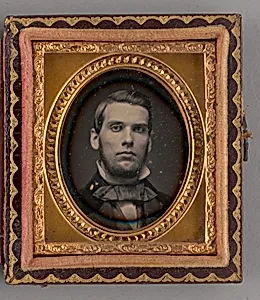
Untitled (Portrait of a Man)
1860
Medium
Daguerreotype
Dimensions
4 × 3.5 cm (1 5/8 × 1 7/16 in.); Open case: 5.1 × 9 × 0.9 cm (2 1/16 × 3 9/16 × 3/8 in.); Case: 5.1 × 4.5 × 1.4 cm (2 1/16 × 1 13/16 × 9/16 in.); Plate: 4.2 × 3.5 cm (1 5/8 × 1 3/8 in.)
Classification
portrait
Department
Photography and Media
Museum
Art Institute of Chicago
Accession Number
249948
Rights
Public Domain
Art Historical Context
Step into the intimate world of 19th-century photography with *Untitled (Portrait of a Man)*, a daguerreotype created around 1860 by an unknown maker. Housed in the Art Institute of Chicago's Photography and Media Department, this tiny portrait—measuring just 4 × 3.5 cm—captures a solemn, unidentified man gazing directly at the viewer. Encased in a protective thermoplastic union case (5.1 × 4.5 × 1.4 cm when closed), it exemplifies the delicate, jewel-like objects that brought photography into everyday life. The daguerreotype, patented by Louis Daguerre in 1839, was the first publicly available photographic process. It produced a one-of-a-kind, highly detailed positive image on a silvered copper plate, polished to a mirror finish and exposed in a camera obscura. No negatives meant each portrait was unique, making it a prized possession. By 1860, as the medium matured, daguerreotypes like this one democratized portraiture, allowing middle-class individuals to afford a "mini-me" far more precise than painted miniatures. This artwork's anonymity underscores photography's cultural shift: from elite commissions to snapshots of ordinary lives. Its diminutive scale invited personal handling, evoking the era's fascination with capturing fleeting identity amid rapid industrialization. A window into Victorian introspection, it reminds us how early photos preserved dignity in miniature form.