
Untitled (Portrait of a Standing Man)
1860s
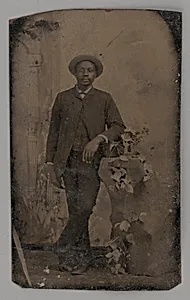
Medium
Tintype
Dimensions
9.3 × 5.6 cm (3 11/16 × 2 1/4 in.); Card: 11 × 8.5 cm (4 3/8 × 3 3/8 in.); Plate: 10.2 × 7.7 cm (4 × 3 in.)
Classification
portrait
Department
Photography and Media
Museum
Art Institute of Chicago
Accession Number
250247
Rights
Public Domain
Art Historical Context
Step into the intimate world of 19th-century photography with *Untitled (Portrait of a Man)*, a tintype from the 186s captured by an unknown maker. This small-scale portrait (9.3 × 5.6 cm) depicts a poised gentleman standing confidently, his attire and stance evoking the everyday formality of mid-Victorian life. Housed in the Art Institute of Chicago's and Media department, it exemplifies the era's democratized portraiture. Tintypes, invented in the 1850s, photography by making images affordable and portable. Produced on thin sheets of iron coated with collodion, these one-of-a-kind positives required no studio grandeur—perfect for itinerant photographers serving working-class families during the Civil War years. Unlike fragile glass ambrotypes, tintypes were durable souvenirs, often tucked into pockets or albums as cherished mementos. The anonymity of both artist and subject adds poignant mystery, inviting us to ponder the man's story amid America's turbulent 1860s. Its modest card mount (11 × 8.5 cm) underscores tintypes' role in preserving personal histories, bridging the gap between painted portraits and modern snapshots for everyday people.