
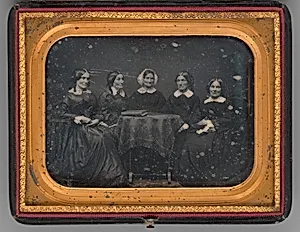
Untitled (Stone Sisters, Lincoln, MA)
Medium
Daguerreotype
Dimensions
10.7 × 14 cm (4 1/4 × 5 9/16 in.); Open case: 15.2 × 24.2 × 1.2 cm (6 × 9 9/16 × 1/2 in.); Case: 15.2 × 12.1 × 2 cm (6 × 4 13/16 × 13/16 in.); Plate: 10.8 × 14 cm (4 1/4 × 5 1/2 in.)
Classification
portrait
Department
Photography and Media
Museum
Art Institute of Chicago
Accession Number
249865
Rights
Public Domain
Art Historical Context
John Adams Whipple’s 1850 daguerreotype captures the Stone Sisters of Lincoln, Massachusetts, in a striking early example of American portrait photography. Created just over a decade after the daguerreotype process was introduced to the public, this work reflects the medium’s rapid adoption in the United States for preserving likenesses of ordinary families. The image, housed in its original protective case, measures roughly 10.7 by 14 centimeters and exemplifies the intimate scale typical of mid-nineteenth-century photographs meant for personal viewing. As one of the first practical photographic techniques, the daguerreotype offered unprecedented detail and realism, allowing viewers to see fine textures in clothing and facial features that paintings could only suggest. Whipple, an innovative Boston photographer, helped popularize the process for portraiture, turning what had been a scientific curiosity into a widely accessible art form. This particular portrait, now in the Art Institute of Chicago’s collection, offers a quiet window into the lives of two young women at a moment when photography was beginning to reshape how people recorded and remembered their personal histories.