
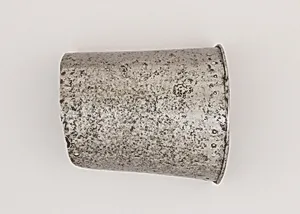
Upper Arm Defense (Rerebrace)
Unknown Artist
ca. 1430–40
Medium
Steel
Dimensions
H. 6 in. (15.2 cm); W. 3 in. (7.6 cm); D. 5 in. (12.7 cm); Wt. 10 oz. (283.5 g)
Classification
Armor Parts
Culture
Italian
Department
Arms and Armor
Museum
Metropolitan Museum of Art, New York, NY
Credit
Bashford Dean Memorial Collection, Bequest of Bashford Dean, 1928
Accession Number
29.150.137
Rights
Public Domain
Art Historical Context
This exquisite *Upper Arm Defense (Rerebrace)*, crafted in Italy around 1430–40, is a finely wrought piece of steel armor designed to shield the upper arm during combat. Measuring just 6 inches high and weighing a mere 10 ounces, its compact form—3 inches wide and 5 inches deep—highlights the remarkable balance of protection and mobility that defined early plate armor. As part of a knight's or soldier's harness, the rerebrace would have been riveted to the shoulder plate (pauldrons) and elbow defense (coulter), forming a seamless layer of defense contoured to the body's natural shape. Dating to the early Renaissance, when Italian armorers were pioneering lightweight, form-fitting designs amid the turbulent wars of city-states like Milan and Florence, this artifact reflects advances in steel forging and tempering. Italian workshops were renowned for their precision hammering and polishing techniques, producing armor that was both functional and aesthetically refined—often etched or gilded in grander sets. Though from an unknown maker, its survival speaks to the era's metallurgical sophistication, transitioning from chainmail to full plate. Now housed in the Metropolitan Museum of Art's Arms and Armor Department, thanks to the Bashford Dean Memorial Collection (1928), this rerebrace offers a tangible glimpse into the chivalric world, reminding us how craftsmanship turned raw steel into lifelike second skins for warriors.