
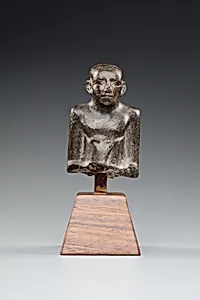
Upper Part of a Seated Figure in a Long Kilt
Unknown Artist
ca. 1800–1650 B.C.
Medium
Serpentinite (?)
Dimensions
H. 7.4 × W. 4.7 × D. 4 cm (2 15/16 × 1 7/8 × 1 9/16 in.)
Classification
Upper Part of a Seated Figure in a Long Kilt
Period
Middle Kingdom
Department
Egyptian Art
Museum
Metropolitan Museum of Art, New York, NY
Credit
Bequest of Nanette B. Kelekian, 2020
Accession Number
2021.41.135
Rights
Public Domain
Art Historical Context
This petite fragment, the *Upper Part of a Seated Figure in a Long Kilt*, hails from Egypt's Middle Kingdom, specifically Dynasty 13 (ca. 1800–1650 B.C.). Carved from serpentinite—a dense, greenish stone prized for its durability—this 7.4 cm tall piece captures the torso and head of a figure clad in a traditional long kilt, a garment symbolizing status among Egyptian elites and officials. Its small scale suggests it was likely part of a votive statue or amulet, offerings placed in temples to invoke divine favor or commemorate the deceased. During the Middle Kingdom, Egypt experienced a cultural renaissance after the chaos of the First Intermediate Period, with sculpture emphasizing idealized proportions and serene expressions to convey eternal stability. Though incomplete, this work exemplifies the era's masterful stone-carving techniques: smooth contours, incised details for musculature and folds, and a forward-facing gaze typical of canonical Egyptian portraiture. The unknown artisan's skill in handling hard serpentinite highlights the period's enduring lapidary traditions, even amid Dynasty 13's political fragmentation. Now at the Metropolitan Museum of Art through the bequest of Nanette B. Kelekian (2020), this fragment offers a tangible link to ancient rituals, reminding us how everyday devotees bridged the mortal and divine worlds through such intimate, enduring art.