
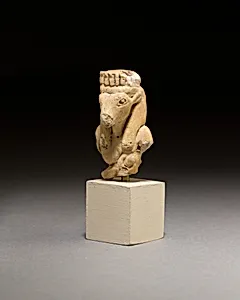
Upper part of a statuette of the Mother of the Apis
Unknown Artist
664–200 B.C.
Medium
Yellow faience
Dimensions
H. 5.6 × W. 3.1 × D. 3 cm (2 3/16 × 1 1/4 × 1 3/16 in.)
Classification
Bust, Mother of the Apis, headdress
Period
Late Period or Ptolemaic Period
Department
Egyptian Art
Museum
Metropolitan Museum of Art, New York, NY
Credit
Gift of Peter Sharrer, 1976
Accession Number
1976.396
Rights
Public Domain
Tags
Art Historical Context
This delicate upper fragment of a statuette depicts the Mother of the Apis, a divine cow goddess revered in ancient Egyptian religion as the nurturer of the sacred Apis bull—an embodiment of the god Ptah and a symbol of fertility and strength. Crafted during the Late Period or Ptolemaic era (664–200 B.C.), when Egypt blended native traditions with Hellenistic influences under Ptolemaic rule, this piece likely served as a votive in temples or private shrines, reflecting devotees' devotion to the Apis cult centered at Memphis. Made of vibrant yellow faience—a glazed ceramic composite of quartz, lime, and copper for its striking color— the statuette showcases Egypt's mastery of this medium. Faience was prized for small-scale sculptures, allowing mass production of affordable, luminous objects that mimicked more precious stones like turquoise. At just 5.6 cm tall, its petite scale highlights the Egyptians' skill in capturing divine majesty in miniature form, with the tag "Isis" suggesting an association with the goddess's protective, maternal aspects. A gift to the Metropolitan Museum of Art in 1976, this artifact invites us to ponder the enduring spiritual role of animals in Egyptian cosmology, bridging everyday piety and cosmic order.