
Upright secretary
ca. 1775–80
Medium
Oak, pine, king-wood, satin-wood, holly, stained woods, satiné, purple-wood, tulipwood, sycamore, gilt bronze, marble
Dimensions
Overall: 56 1/2 × 29 1/2 × 16 in. (143.5 × 74.9 × 40.6 cm)
Classification
Woodwork-Furniture
Culture
French, Paris
Department
European Sculpture and Decorative Arts
Museum
Metropolitan Museum of Art, New York, NY
Credit
Gift of Samuel H. Kress Foundation, 1958
Accession Number
58.75.53
Rights
Public Domain
Art Historical Context
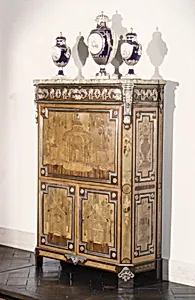
Step into the elegance of 18th-century Paris with this upright secretary by master cabinetmaker Pierre I Rous, crafted around 1775–80. the Louis XVI period, as France transitioned from the opulent Rococo to the refined Neoclassical style, furniture like this became a hallmark of aristocratic interiors. Roussel, a prominent Parisian ébéniste, in such versatile pieces—compact writing desks with upper cabinets for storing letters and documents—perfect for the enlightened salons of the Enlightenment era. The secretary showcases extraordinary craftsmanship through its diverse materials: a sturdy oak and pine core veneered in exotic woods like kingwood, satinwood, tulipwood, and sycamore, adorned with intricate marquetry and stained inlays. Gilt bronze mounts add a luxurious gleam, while the marble top provides a polished surface for writing. These techniques highlight the technical virtuosity of French woodworkers, who sourced rare woods from around the globe to create illusionistic patterns and faux perspectives. A treasured gift to the Metropolitan Museum of Art from the Samuel H. Kress Foundation in 1958, this piece exemplifies the cultural prestige of Parisian decorative arts, blending utility with artistic splendor for the elite.