
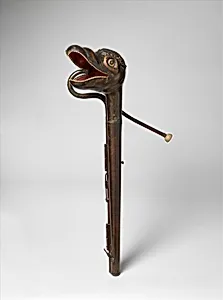
Upright Serpent in D
Unknown Artist
ca. 1810–20
Medium
Brass, paint
Dimensions
35 × 8 15/16 × 16 3/4 in. (88.9 × 22.7 × 42.5 cm)
Classification
Aerophone-Lip Vibrated-horn
Culture
Italian
Department
Musical Instruments
Museum
Metropolitan Museum of Art, New York, NY
Credit
The Crosby Brown Collection of Musical Instruments, 1889
Accession Number
89.4.312
Rights
Public Domain
Tags
Art Historical Context
Nestled in the Metropolitan Museum of Art's renowned Crosby Brown Collection of Musical Instruments the *Upright Serpent in D* (ca. 1810–20) is a captivating Italian brass horn that bl the line between music and sculpture. Standing an impressive 35 inches tall, this aerophone—lip-vibrated like a modern tuba—takes the form of a sinuous, upright serpent, its body coiled and painted for effect. The "ser" name evokes its winding dragon-like shape, a that hints at mythical inspirations blending artistry with functionality. Developed in Europe from the late 16th, the serpent was a versatile bass instrument prized in churches, orchestras, and military bands for its rich, reedy tone. This rare upright Italian variant from the early 19th century reflects Napoleonic-era innovations, when such horns evolved toward the keyed bugles and tubas we know today. Painted embellishments on the brass not only protected the metal but elevated it as a decorative object, suitable for both performance and display. Though by an unknown artist, its craftsmanship showcases Italian metalworking prowess, merging acoustic precision with zoomorphic fantasy. Visitors, imagine the deep, rumbling calls it once produced— a sonic bridge to Romantic-era music halls!