
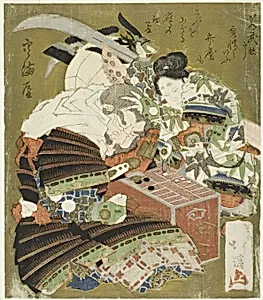
Ushiwakamaru (Minamoto no Yoshitsune) defeats Benkei in a game of sugoroku
c. 1825
Medium
Color woodblock print; shikishiban, surimono
Dimensions
21.8 × 19.1 cm (8 5/8 × 7 9/16 in.)
Classification
woodblock print
Department
Arts of Asia
Museum
Art Institute of Chicago
Accession Number
81008
Rights
Public Domain
Art Historical Context
In this vibrant color woodblock print from around 1825, Totoya Hokkei captures a legendary moment from Japanese folklore: the young warrior Ushiwakamaru—later known as Minamoto no Yoshitsune—triumphantly defeats the mighty monk Benkei in a game of *sugoroku*, a traditional backgammon-like board game. Hokkei, a prominent ukiyo-e artist and pupil of the famed Katsushika Hokusai, renders the scene with playful energy on a compact *shikishiban* format (21.8 × 19.1 cm), typical of luxurious *surimono* prints commissioned for private occasions like New Year's greetings. The depicted duel draws from the epic tale of Yoshitsune and Benkei, popularized in kabuki theater and *nō* drama during the Edo period (1603–1868). In the story, the clever youth outwits the giant warrior at Gojo Bridge in Kyoto, securing Benkei's lifelong loyalty. Such prints celebrated heroic legends, blending history, myth, and entertainment for educated urban audiences, reflecting ukiyo-e's focus on "floating world" pleasures. Hokkei's mastery shines in the *surimono* technique: intricate woodblock carving allows rich colors, metallic accents like mica for shimmer, and subtle embossing for texture. Produced in limited editions with poems often inscribed (though not visible here), these prints were collector's treasures, highlighting the pinnacle of Edo-period printmaking artistry at the Art Institute of Chicago.
About the Artist
Totoya Hokkei · 1780–1850
Totoya Hokkei (魚屋 北渓, 1780–1850), born Iwakubo Tatsuyuki in Edo (modern Tokyo), began his life as a humble fishmonger in the Yotsuya Samegahashi district, a trade reflected in his art name "Totoya," meaning fish shop. He transitioned to art through rigorous training, first studying under Kanō Yōsen'in Korenobu, head of the Kobikichō branch of the prestigious Kanō school, where he honed landscape p...