
唐 鎏金青銅金剛杵|Vajra with Angry Heads and Makara Prongs
Unknown Artist
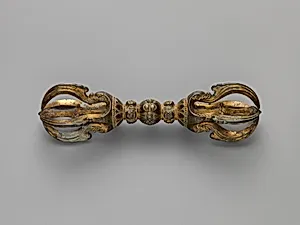
Medium
Gilt bronze
Dimensions
H. 1 1/4 in. (3.2 cm); W. 1 3/4 in. (4.4 cm); L. 8 1/2 in. (21.6 cm)
Classification
Metalwork
Culture & Period
China · Tang dynasty (618–907)
Department
Asian Art
Museum
Metropolitan Museum of Art, New York, NY
Credit
Charlotte C. and John C. Weber Collection, Gift of Charlotte C. and John C. Weber, 1994
Accession Number
1994.605.43
Rights
Public Domain
Art Historical Context
This exquisite gilt bronze vajra, or ritual thunderbolt, hails from China's Tang dynasty (618–), a golden era of cosmopolitan culture and Buddhist flourishing along the Silk Road. Measuring just 8½ inches long, this handheld implement the period's masterful metalwork, crafted for esoteric Tantric Buddhist ceremonies. The title reveals its dramatic features: snarling angry heads symbolizing wrathful deities that conquer ignorance, and makara prongs—fierce, mythical aquatic creatures from Indian lore—adding symbolic power. Forged in bronze and lavishly gilded with gold, the vajra's surface gleams with intricate detailing, showcasing Tang artisans' lost-wax casting techniques and mercury gilding for a radiant finish. Its compact size (1¼ inches high, 1¾ inches wide) made it ideal for ritual use by monks or as a votive object, embodying the indestructible diamond-like nature of enlightenment in Vajrayana Buddhism. In Tang China, where Buddhism blended with Daoism and local traditions, such vajras bridged Indian esotericism and Chinese aesthetics, highlighting the dynasty's role as a cultural crossroads. Donated to the Metropolitan Museum of Art from the Charlotte C. and John C. Weber Collection, it invites visitors to ponder the thunderous force of spiritual transformation in miniature form.