
Valentine
mid 19th century
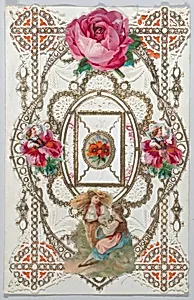
Medium
Collage, colored papers, lace paper, chromolithographed die-cut scraps
Dimensions
3 15/16 in. (10 cm) width 6 1/8 in (15.6 cm) length
Classification
Ephemera|Drawings
Department
Drawings and Prints
Museum
Metropolitan Museum of Art, New York, NY
Credit
Gift of Mrs. Richard Riddell, 1981
Accession Number
1981.1136.561
Rights
Public Domain
Art Historical Context
Step into the sentimental world of mid-19th-century America with *Valentine*, a delicate creation by Esther Howland, hailed as the "Mother of the American." Produced around the 1840s–1850s in Worcester Massachusetts, this ephemera exemplifies the burgeoning popularity of Valentine's Day cards during the Victorian era. Howland, inspired by English imports, revolutionized the industry by crafting affordable, mass-produced yet intricately personalized tokens of affection, transforming fleeting emotions into tangible keepsakes. Measuring just 3 15/16 by 6 1/8 inches, this petite collage masterfully layers colored papers, ornate lace paper, and chromolithographed die-cut scraps—vibrant, printed images that were cutting-edge for the time. Chromolithography allowed for vivid colors and mass replication, while the collage technique invited tactile depth with embossed edges and filigree details, blending artistry with accessibility. Classified as both ephemera and drawings, it bridges folk craft and fine art. Housed in the Metropolitan Museum of Art's Drawings and Prints department (gift of Mrs. Richard Riddell, 1981), *Valentine* captures the cultural shift toward commercialized romance, preserving a slice of everyday Victorian sentiment that might otherwise have vanished. A testament to Howland's ingenuity, it reminds us how paper scraps became vessels for love.
About the Artist
Esther Howland · 1828–1904
American, Worcester, Massachusetts 1828–1904 Quincy, Massachusetts