
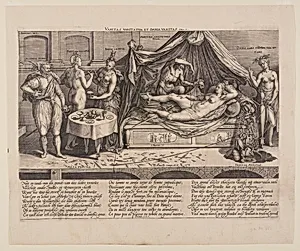
Vanitas
Medium
Engraving on ivory laid paper
Dimensions
Plate: 24.5 × 32.4 cm (9 11/16 × 12 13/16 in.); sheet: 30 × 35.5 cm (11 13/16 × 14 in.)
Classification
engraving
Department
Prints and Drawings
Museum
Art Institute of Chicago
Accession Number
268382
Rights
Public Domain
Art Historical Context
Created in 1578 by the Flemish engraver Hieronymus Wierix, *Vanitas* exemplifies the moralizing imagery popular in Northern Europe during the late Renaissance. The title refers to a longstanding artistic tradition that uses symbols—such as skulls, wilting flowers, or extinguished candles—to remind viewers of life’s fleeting nature and the inevitability of death. Wierix, working in Antwerp, specialized in finely detailed prints that blended religious devotion with allegorical messages, making complex ideas accessible to a broad audience. As an engraving printed on ivory laid paper, the work highlights the importance of printmaking in the sixteenth century. Unlike unique paintings, engravings could be produced in multiples and circulated widely, allowing moral and devotional imagery to reach collectors, scholars, and households across Europe. The crisp lines and tonal contrasts typical of the medium let Wierix render intricate details with remarkable precision. Today, this impression resides in the Art Institute of Chicago’s Department of Prints and Drawings, where it offers visitors a window into early modern concerns about mortality and the enduring power of reproducible art.