
Vanity
1545–50
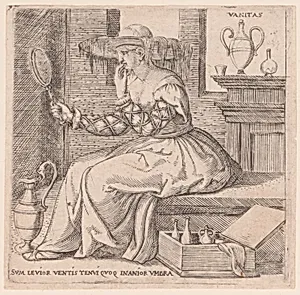
Medium
Engraving
Dimensions
sheet: 3 1/16 x 3 3/16 in. (7.8 x 8.1 cm) trimmed just outside plate
Classification
Prints
Department
Drawings and Prints
Museum
Metropolitan Museum of Art, New York, NY
Credit
The Elisha Whittelsey Collection, The Elisha Whittelsey Fund, 1949
Accession Number
49.97.365
Rights
Public Domain
Tags
About this artwork
This Vanity by Enea Vico dating to 1545–50 exemplifies the period. Created in engraving, the work demonstrates technical mastery of materials and processes characteristic of the era. As part of the Metropolitan Museum of Art's Drawings and Prints, this piece contributes to our understanding of historical artistic production. Prints from this period served diverse functions—artistic expression, documentation, commercial distribution, and cultural commentary—reflecting the broader democratization ...
Art Historical Context
Enea Vico's *Vanity*, an engraving from around 1545–50, captures the elegance and technical prowess of Renaissance printmaking. This intimate work, measuring just 3 1/16 x 3 3/16 inches (7.8 x 8.1 cm) and trimmed close to the plate edges, showcases Vico's mastery of the burin—a sharp tool used to incise fine lines into a copper plate, allowing for precise shading and intricate details. As a leading Italian engraver of his time, Vico exemplified the era's shift toward reproductive prints that could disseminate images widely beyond original paintings. The title *Vanity* and motifs of women with mirrors evoke the vanitas tradition, a cultural commentary on fleeting beauty and human folly popular in 16th-century Europe. Prints like this served multiple roles: artistic expression, documentation of designs, and commercial ventures that made high art accessible to a broader audience, from nobility to merchants. Housed in the Metropolitan Museum of Art's Drawings and Prints department (The Elisha Whittelsey Collection, 1949), it highlights how engraving revolutionized visual culture, bridging elite patronage with popular reception. Today, *Vanity* invites us to ponder timeless themes through Vico's delicate lines, reminding visitors of art's power to both decorate and provoke thought in Renaissance society.
About the Artist
Enea Vico · 1523–1567
Enea Vico (1523–1567) was born in Parma and came of age during the final, energetic decades of Italian Renaissance printmaking. By 1541 he had made his way to Rome, where he entered the orbit of the engraver and publisher Tommaso Barlacchi and began his professional career. In Rome, Vico encountered the work of the most celebrated printmakers of the preceding generation—Marcantonio Raimondi, Agost...