
Vase
Unknown Artist
1865–71
Medium
Cloisonné enamel
Dimensions
H. 24 3/4 in. (62.9 cm); W. 10 3/4 in. (27.3 cm); D. 10 3/4 in. (27.3 cm) Diam. of rim: 10 5/8 in. (27 cm) Diam. of foot: 7 in. (17.8 cm)
Classification
Cloisonné
Culture & Period
Japan · Edo (1615–1868) or Meiji period (1868–1912)
Department
Asian Art
Museum
Metropolitan Museum of Art, New York, NY
Credit
Gift of Mrs. Russell Sage, 1916
Accession Number
16.98.1
Rights
Public Domain
Tags
Art Historical Context
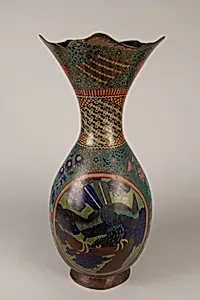
This elegant vase, crafted in Japan between 1865 and 1871, captures a pivotal moment in the nation's artistic history. Created during the final years of the Edo period or the early Meiji era, it reflects Japan's increasing engagement with international trade and Western interest in Japanese decorative arts. The unknown artist employed cloisonné enamel, a technique in which thin metal wires form delicate compartments on the surface, filled with vibrant colored enamels and fired to create luminous, jewel-like effects. Such works were often produced for export, showcasing Japan's refined craftsmanship to global audiences. The medium's significance lies in its demanding precision and luminous beauty, allowing for intricate designs that could mimic the richness of painting or embroidery on a three-dimensional form. Here, the vase features motifs of birds, evoking themes of nature and seasonal change cherished in Japanese aesthetics. Standing over two feet tall, its balanced proportions and detailed enamel work highlight the technical mastery achieved by artisans during this transitional time. Acquired by the Metropolitan Museum of Art as a gift in 1916, this piece offers visitors a glimpse into Japan's evolving cultural identity as it moved from isolation toward modernization while preserving traditional artistic excellence.