
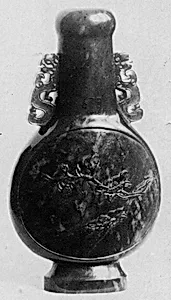
Vase
Unknown Artist
Medium
Nephrite, dark olive-green, translucent, and mottled by lighter shades
Dimensions
H. 4 15/16 in. (12.6 cm); W. 2 11/16 in. (6.8 cm); D. 1 3/16 in. (3 cm)
Classification
Jade
Culture & Period
China · Qing dynasty (1644–1911), Qianlong period (1736–95)
Department
Asian Art
Museum
Metropolitan Museum of Art, New York, NY
Credit
Gift of Heber R. Bishop, 1902
Accession Number
02.18.673
Rights
Public Domain
Art Historical Context
This exquisite nephrite jade vase, carved from dark olive-green stone translucent and mottled with lighter shades, hails from China's Qing dynasty during the Qianlong period (173695). Standing just under 5 inches tall (H. 4 15/16 in.), with a width of 2 11/16 in. and depth 1 3/16 in., its petite scale suggests it was designed as a refined table ornament or incense holder for scholarly elites or imperial collections. Nephrite, one of China's most revered materials since ancient times, was prized for its toughness and luminous quality, often symbolizing purity and imperial virtue. The Qianlong era marked a pinnacle of jade craftsmanship, where master carvers employed intricate techniques like incising and polishing to achieve a smooth, glowing finish that highlights the stone's natural veining. Though the artist's identity remains unknown, such vases exemplify the period's opulent aesthetic, blending functionality with artistic virtuosity amid the empire's prosperity. This piece entered the Metropolitan Museum of Art as a gift from Heber R. Bishop in 1902, joining treasures that illuminate China's enduring jade tradition. (178 words)