
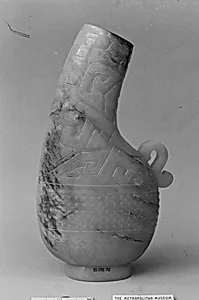
Vase
Unknown Artist
Medium
Nephrite
Dimensions
H. 8 3/4 in. (22.2 cm); W. 5 in. (12.7 cm)
Classification
Jade
Culture & Period
China · Ming dynasty (1368–1644)
Department
Asian Art
Museum
Metropolitan Museum of Art, New York, NY
Credit
Bequest of Edmund C. Converse, 1921
Accession Number
21.175.72
Rights
Public Domain
Art Historical Context
This exquisite nephrite jade vase, from China's Ming dynasty (1368–1644), embodies the era's reverence for jade as a material of profound cultural and spiritual significance. Nephrite, prized for its toughness and subtle green translucency, was meticulously carved into vessels like this one, measuring 8¾ inches (22.2 cm) in height and 5 inches12.7 cm) wide. During the Ming period, jade craftsmanship flourished under imperial patronage, with artisans employing time-honored techniques to shape raw boulders into elegant forms, often evoking harmony with nature. In Chinese tradition, jade symbolized purity, immortality, and imperial virtue, making such vases ideal for scholarly display, ritual use, or as status symbols among the elite. Though the artist and precise date are unknown, this piece reflects Ming jade's hallmark refinement—smooth surfaces and balanced proportions that highlight the stone's natural beauty without ostentation. Today, housed in the Metropolitan Museum of Art's Asian Art Department through the 1921 bequest of Edmund C. Converse, it offers visitors a tangible link to Ming opulence, inviting quiet admiration of ancient mastery.