
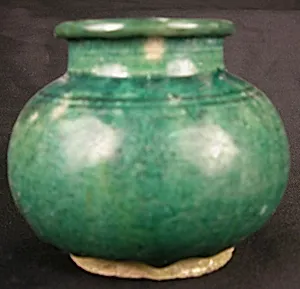
Vase
Unknown Artist
12th century
Medium
Earthenware; glazed and luster-painted
Dimensions
H. 3 3/8 in. (8.6 cm) Diam. foot 2 1/2 in. (6.4 cm) Diam. rim 2 7/16 in. (6.2 cm) Diam. body 4 in. (10.2 cm)
Classification
Ceramics
Department
Islamic Art
Museum
Metropolitan Museum of Art, New York, NY
Credit
Gift of Charles K. Wilkinson, 1981
Accession Number
1981.88
Rights
Public Domain
Art Historical Context
This delicate 12th-century earthen vase, standing just over 3 inches tall, exemplifies the exquisite ceramics of the Islamic world.ed with a glazed surface and luster-painted decoration it features the innovative technique of applying metallic oxides over a tin-glazed base and firing in a reducing atmosphere to create a shimmering, iridescent effect. This lusterware process, perfected by artisans in regions like Iraq, Iran, and Syria during the medieval Islamic golden age, mimicked the glow of precious metals, making such vessels status symbols for elite households. Though the artist remains unknown, the vase's modest dimensions—widest at 4 inches across the body—suggest it served practical yet artistic purposes, perhaps holding perfumes, spices, or flowers on a scholarly's desk or dining table. Luster-painted ceramics reached their zenith in the 12th century under Seljuk patronage, blending functionality with abstract motifs that reflected Islamic aesthetics of geometry and luminescence, avoiding figurative representation. Today, this gem from the Metropolitan Museum of Art's Islamic Art Department, gifted by Charles K. Wilkinson in 1981, invites us to marvel at the technical mastery and cultural refinement of medieval Islamic potters, whose innovations influenced global ceramics for centuries.