
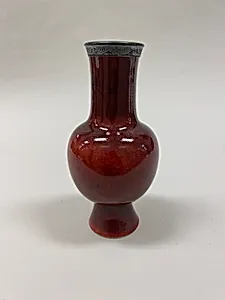
Vase
Unknown Artist
18th century
Medium
Porcelain with ox-blood glaze (Jingdezhen ware), with silver mounts
Dimensions
H. 7 in. (17.8 cm); Diam. 3 1/2 in. (8.9 cm)
Classification
Ceramics
Culture & Period
China · Qing dynasty (1644–1911)
Department
Asian Art
Museum
Metropolitan Museum of Art, New York, NY
Credit
Bequest of Benjamin Altman, 1913
Accession Number
14.40.56
Rights
Public Domain
Art Historical Context
This elegant porcelain vase, crafted in China's Jingdezhen kilns during the 18th century Qing dynasty (1644–1911), the era's mastery of ceramic artistry. Standing just 7 inches tall with a 3½-inch diameter, its compact form is adorned with a rare ox-blood glaze—known as *sang de bœuf* for its deep, rich crimson hue resembling oxidized blood. Jingdezhen, the porcelain capital of the world, produced wares for imperial courts under emperors like Kangxi andlong, where such glazes were highly prized for their difficulty to achieve, requiring precise high-temperature firing to yield the glossy, crackled finish. The vase's silver mounts, likely added later for European display, highlight its journey along global trade routes, blending Chinese technical brilliance with Western decorative tastes. Ox-blood glazes symbolized luxury and imperial prestige, often reserved for elite collectors. This piece entered the Metropolitan Museum of Art through the 1913 bequest of Benjamin Altman, a prominent New York merchant whose Asian art collection enriched public appreciation of Qing porcelain. Today, it invites us to marvel at Qing innovation, where potters pushed ceramic boundaries, creating enduring treasures that bridged East and West.