
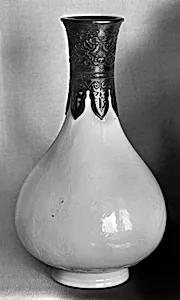
Vase
Unknown Artist
early 18th century
Medium
Porcelain with incised decoration under clear glaze (Jingdezhen ware), silver mounts
Dimensions
H. 6 in. (15.2 cm)
Classification
Ceramics
Culture & Period
China · Qing dynasty (1644–1911), Yongzheng period (1723–35)
Department
Asian Art
Museum
Metropolitan Museum of Art, New York, NY
Credit
Bequest of Benjamin Altman, 1913
Accession Number
14.40.153
Rights
Public Domain
Art Historical Context
This exquisite porcelain vase, crafted in Jingdezhen—the renowned center of Chinese porcelain production—dates to the early 18th during the Qing dynasty's Yongzheng period1723–35). Standing just 6 inches tall, it exemplifies the era's pursuit of refined elegance and technical mastery. Jingdezhen kilns supplied the imperial court with flawless wares, and this piece reflects that prestige through its delicate form and subtle sophistication. The vase features incised decoration carved directly into the unfired clay body, then sealed beneath a crystal-clear glaze that highlights the intricate lines with luminous depth. This labor-intensive technique, known as incising or sgraffito, allowed artisans to create fine motifs without added pigments, emphasizing purity and precision. Later silver mounts, likely added in Europe, transformed it into a functional luxury item, perhaps a scent flask or ornamental cup, bridging Chinese craftsmanship with Western tastes. Bequeathed to the Metropolitan Museum of Art by Benjamin Altman in 1913, this vase captures the global allure of Qing porcelain, symbolizing cultural exchange and the artistry that made Chinese ceramics treasures worldwide. A testament to Yongzheng refinement, it invites visitors to appreciate the subtle beauty born of imperial innovation.