
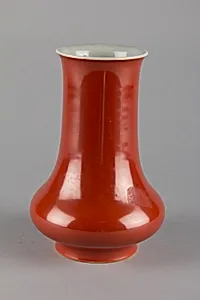
Vase
Unknown Artist
18th century
Medium
Porcelain with coral red glaze (Jingdezhen ware)
Dimensions
H. 7 5/8 in. (19.4 cm); Diam. 3 1/4 in. (8.3 cm)
Classification
Ceramics
Culture & Period
China · Qing dynasty (1644–1911)
Department
Asian Art
Museum
Metropolitan Museum of Art, New York, NY
Credit
Bequest of Robert West, 1950
Accession Number
50.221.48
Rights
Public Domain
Art Historical Context
This elegant porcelain vase, crafted in China's Jingdezhen kilns during the 18th century Qing dynasty (1644–1911), exemplifies the pinnacle of imperial ceramic artistry. Standing just 7⅝ inches tall with a 3¼-inch diameter, its petite form was ideal for scholarly display or as a vessel for precious inks and brushes, reflecting the refined tastes of the era's elite. Produced at Jingdezhen—the world's foremost porcelain center since the 14th century—this piece hails from a time when the Qing court monopolized the finest wares, exporting them globally as symbols of Chinese ingenuity. The vase's coral red glaze, a vibrant and challenging hue achieved through precise copper-oxide firing at extreme temperatures (around 1,300°C), is a hallmark of Qing technical mastery. Known as "sang de bœuf" or oxblood in Western collections, this glossy, even red demanded exceptional skill to avoid bubbling or fading, making it rarer and more prestigious than blue-and-white porcelains. Such glazes evoked the luxury of coral, a prized import, underscoring the object's status. Bequeathed to the Metropolitan Museum of Art by Robert West in 1950, this anonymous masterpiece invites us to marvel at Qing porcelain's enduring legacy—bridging artistry, technology, and cultural prestige in a single, luminous form.