
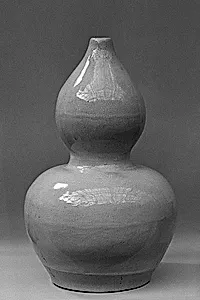
Vase
Unknown Artist
Medium
Porcelaneous ware with crackled white glaze
Dimensions
H. 13 1/2 in. (34.3 cm); Diam. 8 1/2 in. (21.6 cm); Diam. of rim 1 in. (2.5 cm); Diam. of base 5 1/2 in. (14 cm)
Classification
Ceramics
Culture & Period
China · Ming dynasty (1368–1644)
Department
Asian Art
Museum
Metropolitan Museum of Art, New York, NY
Credit
H. O. Havemeyer Collection, Bequest of Mrs. H. O. Havemeyer, 1929
Accession Number
29.100.251
Rights
Public Domain
Art Historical Context
This elegant vase, crafted in China during the Ming dynasty (8–1644), exemplifies the era's mastery of ceramic artistry. Standing at 13½ inches tall with a slender profile—8½ inches in diameter at its widest, tapering to a narrow 1-inch rim and a 5½-inch base—it was made from porcelaneous ware, a high-fired stoneware that mimics true porcelain's translucency and durability. The defining feature is its crackled glaze, where intentional fine fissures form a delicate, ice-like texture as the glaze contracts differently from the body during cooling, creating a subtle, aged patina prized for its refined beauty. Ming ceramics, produced at imperial kilns like those in Jingdezhen, represented the pinnacle of technical innovation and aesthetic purity. White monochromes such as this were favored for their minimalist elegance, often used in scholarly studios, temples, or elite homes to hold flowers, incense, or offerings. The crackle effect, known as "crackle ware" or *binglie*, symbolized natural imperfection akin to cracked ice, evoking purity and transience in Daoist and Confucian ideals. A gift from the H.O. Havemeyer Collection to The Metropolitan Museum of Art in 1929, this anonymous masterpiece invites us to appreciate the Ming potters' anonymous genius—where form, glaze, and cultural harmony speak volumes without ornament.