
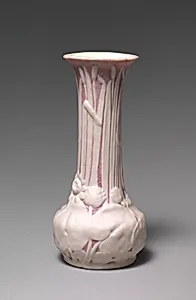
Vase
Unknown Artist
1830–70
Medium
Parian porcelain
Dimensions
4 3/4 x 2 1/4 in. (12.1 x 5.7 cm)
Classification
Vase
Culture
American
Department
The American Wing
Museum
Metropolitan Museum of Art, New York, NY
Credit
Gift of Dr. Charles W. Green, 1947
Accession Number
47.90.44
Rights
Public Domain
Tags
Art Historical Context
This delicate Parian porcelain vase, by an unknown American artist between 1830 and 1870, exemplifies the refined decorative arts of mid-19-century America. Standing just 4 3/4 inches tall, its petite form (4 3/4 x 2 1/4 in.) made it ideal for Victorian parlors, where such objects adorned mantelpieces and tabletops. Parian porcelain an unglazed, matte-white material resembling fine marble, was a popular innovation of the era, prized for its smooth, biscuit-like texture that highlighted intricate details without the sheen of traditional glaze. The vase likely features floral motifs—a hallmark of American Parian ware—evoking the era's Romantic fascination with nature's beauty amid rapid industrialization. Produced during a boom in domestic pottery, these vases reflected growing middle-class aspirations for elegant, affordable home decor, often inspired by European styles but adapted for American tastes. Housed in The Metropolitan Museum of Art's American Wing, this piece was generously gifted by Dr. Charles W. Green in 1947, preserving a snapshot of everyday luxury from the antebellum and post-Civil War periods. Today, it invites us to appreciate the artistry in subtlety: how skilled potters captured fleeting blossoms in enduring porcelain, bridging utility and ornament in America's cultural story.