
Vase
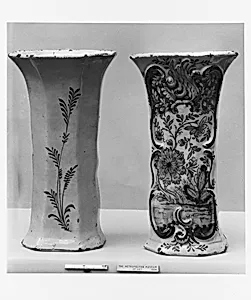
Medium
Earthenware
Dimensions
H. 10 3/8 in. (26.4 cm)
Classification
Vase
Culture
Dutch
Department
The American Wing
Museum
Metropolitan Museum of Art, New York, NY
Credit
Rogers Fund, 1926
Accession Number
26.25.4
Rights
Public Domain
Tags
Art Historical Context
This charming earthenware vase, crafted between 1739 and 1775 by Justus Brou of The Porcelain Axe workshop, exemplifies Dutch ceramic artistry from the mid-18th century. Standing at 10 3/8 inches (26.4 cm) tall, it reflects the era's fascination with decorative household objects that brought elegance to everyday life. Earthenware, at lower temperatures than porcelain, allowed for vibrant glazes and intricate designs while remaining affordable, making such vases staples in Dutch homes and beyond. Adorned with floral motifs—evident from its tags—the vase captures the Dutch Golden Age's lingering love for nature-inspired decoration. Flowers symbolized prosperity and beauty in 17th- and 18th-century Europe, often hand-painted with bold colors and stylized blooms to mimic the abundance of tulip mania and botanical illustrations. The Porcelain Axe, likely a specialized studio, contributed to Holland's robust pottery tradition, blending functionality with folkloric charm. Acquired through the Rogers Fund in 1926 and housed in The Metropolitan Museum of Art's American Wing, this piece bridges European craftsmanship with transatlantic collecting tastes. It invites visitors to appreciate how Dutch earthenware influenced global design, offering a tangible glimpse into 18th-century domestic refinement.
About the Artist
Justus Brouwer|The Porcelain Axe ( |Dutch) · |1739 – |1775
|Dutch, active 1739–1775