
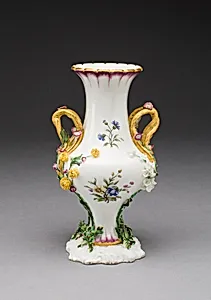
Vase
c. 1749–52
Medium
Soft-paste porcelain, polychrome enamels, and gilding
Dimensions
19.3 × 11 × 9.6 cm (7 9/16 × 4 5/16 × 3 3/4 in.)
Classification
vase
Department
Applied Arts of Europe
Museum
Art Institute of Chicago
Accession Number
10890
Rights
Public Domain
About this artwork
As the artistic director of the Vincennes Porcelain Manufactory, the Italian-born goldsmith and designer Jean-Claude Duplessis (c. 1695–1774) was responsible for many of the innovative forms of the Rococo and early Neoclassical styles that the factory produced. Duplessis designed porcelain vases, tea and dinnerwares, and gilt-bronze mounts for porcelain. These objects often possess a particularly sensual and organic quality that was new to porcelain at the time.
Art Historical Context
This elegant vase, crafted by Jean-Claude Dupless around 1749–52, exemplifies the pinnacle of mid-18th-century French porcelain artistry. Measuring 19.3 × 11 × 9.6 cm, it is fashioned from soft-paste porcelain delicate, translucent material developed in France to rival German hard-paste wares—enhanced with vibrant polychrome enamels and intricate gilding. Housed in the Art Institute Chicago's Department of Applied Arts of Europe, it reflects the opulent Rococo style favored by Louis XV's court. Duplessis, a talented sculptor and modeler who became artistic director at the Vincennes royal porcelain manufactory (predecessor to Sèvres) in 1748, played a key role in elevating French ceramics. During this era, Vincennes porcelain symbolized national prestige, with pieces like this vase commissioned for aristocratic interiors. The soft-paste formula, fired at lower temperatures, allowed for slender shapes and fine details impossible in earlier materials. The polychrome enamels provided a spectrum of rich colors, while gilding added shimmering luxury, showcasing the factory's technical mastery. Such vases were not mere vessels but status symbols, blending functionality with sculptural flair and underscoring France's dominance in decorative arts during the Ancien Régime.