
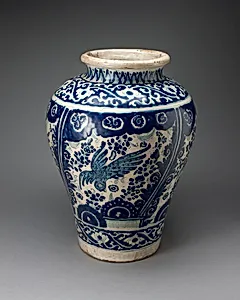
Vase Depicting a Phoenixlike Bird
1700–50
Medium
Tin-glazed earthenware
Dimensions
H.: 49 cm (19 1/4 in.)
Classification
earthenware
Department
Arts of the Americas
Museum
Art Institute of Chicago
Accession Number
10435
Rights
Public Domain
About this artwork
Chinese blue-and-white porcelain arrived in the Americas during the 1570s, when the Manila Galleons began crossing the Pacific Ocean from Mexico to the Spanish Philippines and back. Cargoes of Asian luxury goods landing at Acapulco were transshipped to Colonial Mexico City and Puebla, where they remained until shipment continued across the Atlantic Ocean to Seville. A thriving ceramic industry developed in Puebla, producing glazed earthenware imitating porcelain and freely adapting Chinese desig...
Art Historical Context
Step into the luminous world of colonial Mexican ceramics with this striking *Vase Depicting alike Bird*, a masterpiece of Talavera Poblana pottery from Puebla, Mexico, dating to 1700–50. Standing at an impressive 49 cm, this tin-glazed earthenware vessel exemplifies the artistry of New Spain's workshops, where skilled potters fused European techniques with local flair. Talavera Poblana, after the city of Puebla, is renowned for its vibrant maiolica-style glazing—a tin-oxide coating fired over earthenware to create a brilliant white surface ideal for bold painted motifs. Here, the phoenixlike bird soars in vivid blues, yellows, and greens, symbolizing rebirth and eternity, a motif that blends European heraldry with Mesoamerican mythology. This labor-intensive process, involving multiple firings, produced durable yet decorative pieces for homes, altars, and exports. Housed in the Art Institute of Chicago's Arts of the Americas department, this vase highlights the cultural mestizaje of the colonial era, where Spanish artisans trained Indigenous and mestizo craftsmen. It stands as a testament to Puebla's enduring ceramic legacy, now a UNESCO-recognized tradition, inviting us to admire the harmonious fusion of old worlds in enduring clay.