
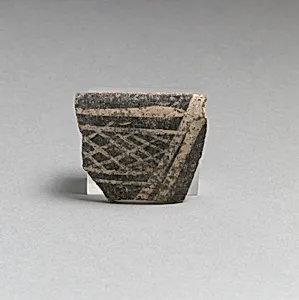
Vase fragment
Unknown Artist
Medium
Terracotta
Dimensions
1 1/2 × 1 11/16 × 3/16 in. (3.9 × 4.3 × 0.6 cm)
Classification
Vases
Culture & Period
Minoan · Early Minoan III
Department
Greek and Roman Art
Museum
Metropolitan Museum of Art, New York, NY
Credit
Gift of the American Exploration Society, 1907
Accession Number
07.232.80
Rights
Public Domain
Art Historical Context
This delicate terracotta vase fragment,ailing from Early Minoan III (ca. 2300–2100 BCE), offers a tantalizing glimpse into one of the ancient world's most enigmatic civilizations on Crete. Measuring just 1 1/2 × 1 11/16 × 3/16 inches, this tiny shard from the Metropolitan Museum of Art's Greek and Roman Art Department the everyday pottery of the Minoans, crafted from fired clay abundant on the island. Minoan vase-making marked a leap in Bronze Age ceramics, with potters shaping vessels for storage, trade, and ritual use, often featuring early incised or painted motifs that foreshadowed the vibrant frescoes of later palaces like Knossos. Though incomplete and unattributed to a specific artist, the fragment's survival underscores the durability of terracotta and the ingenuity of Minoan artisans, who wheel-threw or hand-built pots with precise control. Donated in 1907 by the American Exploration Society, it reflects early 20th-century enthusiasm for excavating Crete's lost world, immortalized by Arthur Evans. For visitors, this unassuming piece evokes the bustling ports and fertile fields of Minoan society—a precursor to classical Greek culture—reminding us how even fragments preserve profound histories. (198 words)