
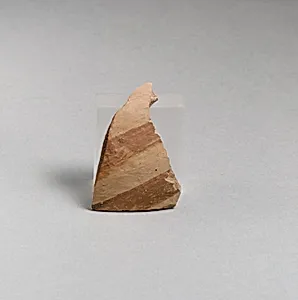
Vase fragment
Unknown Artist
ca. 1600–1450 BCE
Medium
Terracotta
Dimensions
1 7/8 × 1 7/16 × 1/8 in. (4.8 × 3.7 × 0.4 cm)
Classification
Vases
Culture & Period
Minoan · Late Minoan I
Department
Greek and Roman Art
Museum
Metropolitan Museum of Art, New York, NY
Credit
Gift of the American Exploration Society, 1907
Accession Number
07.232.88f
Rights
Public Domain
Art Historical Context
This delicate terracotta vase fragment hails from the vibrant Minoan civilization of Crete, dating to the Late Minoan I periodca. 1600–1450 BCE). At just under 2 inches tall, it offers a tantalizing glimpse into the daily artistry of Bronze Age Crete, where skilled potters crafted vessels for storage, trade, and ritual use. Minoans were master ceramicists, firing terracotta—clay mixed with sand or grit—on fast-spinning potter's wheels to create thin-walled pots renowned for their durability and elegance. Though only a small shard survives, it embodies the cultural zenith of Minoan society, centered around grand palaces like Knossos. Pottery like this facilitated extensive Mediterranean trade networks, carrying olive oil, wine, and goods that connected Crete to Egypt, the Cyclades, and beyond. The use of terracotta highlights practical innovation: its reddish hue from iron-rich clay, often burnished for a smooth finish, made it ideal for both functional and decorative purposes. Today, this fragment graces the Metropolitan Museum of Art's Greek and Roman Art department, a gift from the American Exploration Society in 1907. It reminds us how even broken pieces preserve the ingenuity of a lost world, inviting us to ponder the hands that shaped it millennia ago.