
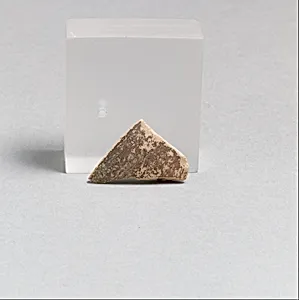
Vase fragment
Unknown Artist
Medium
Terracotta
Dimensions
5/8 × 15/16 × 1/8 in. (1.6 × 2.4 × 0.4 cm)
Classification
Vases
Culture
Minoan
Department
Greek and Roman Art
Museum
Metropolitan Museum of Art, New York, NY
Credit
Gift of the American Exploration Society, 1907
Accession Number
07.232.239
Rights
Public Domain
Art Historical Context
This delicate terracotta vase fragment offers a tantalizing glimpse into the vibrant world of Minoan culture, flourishing on the island of Crete during the Bronze Age (circa 3000–1100 BCE). As part of the Metropolitan Museum of Art's Greek and Roman Art collection, it exemplifies the everyday artistry of a seafaring civilization renowned for its sophisticated palaces, frescoes, and intricate pottery. Though tiny—measuring just 5/8 × 15/16 × 1/8 inches—this shard underscores how even small survivals from antiquity preserve invaluable cultural echoes. Terracotta, a fired clay medium, was a staple in Minoan vase-making, allowing for durable yet lightweight vessels used in trade, rituals, and daily life. Minoan potters excelled in wheel-throwing techniques and vibrant decorations, often featuring marine motifs, stylized flora, or abstract patterns that influenced later Greek art. While the precise decoration on this fragment remains unnoted, its classification as a vase piece highlights the Minoans' mastery of form and function, bridging utility with aesthetic grace. Generously gifted by the American Exploration Society in 1907, this artifact connects us to early 20th-century archaeological fervor, when sites like Knossos yielded treasures revealing Minoan ingenuity. For visitors, it invites wonder at how a single fragment speaks volumes about a lost society's creativity and resilience.