
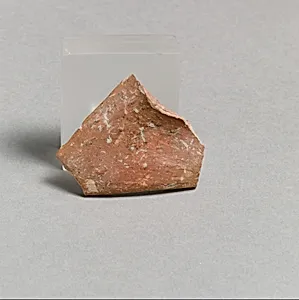
Vase fragment
Unknown Artist
ca. 3000–2200 BCE
Medium
Terracotta
Dimensions
1 9/16 x 1 1/4in. (3.9 x 3.2cm)
Classification
Vases
Period
Early Helladic
Department
Greek and Roman Art
Museum
Metropolitan Museum of Art, New York, NY
Credit
Gift of Gisela M. A. Richter, 1923
Accession Number
23.121.7
Rights
Public Domain
Art Historical Context
This delicate terracotta vase fragment, to the Early Helladic period (. 3000–2200 BCE), offers a glimpse into the daily life of prehistoric Greece during the Early Bronze Age. Measuring just 1 9/16 x 1 1/4 inches, it is a modest survivor from a larger vessel, likely used for storing grains, liquids, or other household essentials. Crafted from fired clay—a ubiquitous medium in ancient Aegean cultures—such fragments highlight the foundational pottery traditions that preceded the more ornate ceramics of later Greek eras. In the Early Helladic phase, mainland Greece saw the rise of settled farming communities and early metallurgy, with terracotta vases forming the backbone of domestic utility. Hand-formed or wheel-thrown on rudimentary devices, these objects were practical yet reveal evolving technical skills, like controlled firing for durability. Though decoration is minimal on this shard, it embodies the unadorned functionality that defined pre-Mycenaean society, bridging Neolithic simplicity and Bronze Age innovation. Generously gifted to the Metropolitan Museum of Art in 1923 by esteemed scholar Gisela M. A. Richter, this piece enriches our understanding of Greece's ancient roots. Displayed in the Greek and Roman Art department, it reminds us how even tiny artifacts preserve the voices of anonymous artisans from over 4,000 years ago.