
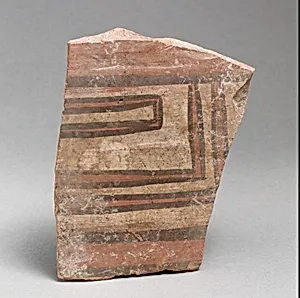
Vase fragment
Unknown Artist
Medium
Terracotta
Dimensions
Overall: 4 5/8 x 3 7/16in. (11.7 x 8.8cm)
Classification
Vases
Culture & Period
East Greek/Sardis, Lydian · Archaic
Department
Greek and Roman Art
Museum
Metropolitan Museum of Art, New York, NY
Credit
Gift of The American Society for the Excavation of Sardis, 1926
Accession Number
26.199.128
Rights
Public Domain
Art Historical Context
This delicate terracotta vase fragment hails from the ancient city of Sardis, the opulent capital of Lydia in what is now western Turkey. Dating to the Archaic period (c. 800–480 BCE), it exemplifies East Greek pottery traditions influenced by Lydian culture, a prosperous kingdom famed for its gold reserves and King Croesus's legendary wealth. Unearthed during excavations sponsored by the American Society for Excavation of Sardis it entered the Metropolitan Museum of Art 1926 as a gift, offering a tangible link to this vibrant crossroads of Greek and Anatolian worlds. Though only a small piece measuring 4⅝ × 3⅜ inches, its survival speaks to the durability of terracotta—a fired clay medium prized for its affordability and versatility in ancient vase-making. Craftsmen likely shaped it on a potter's wheel, possibly decorating it with slip paints or incised patterns typical of East Greek wares, blending utilitarian function with artistic flair for storage, trade, or rituals. As a window into Archaic daily life, this fragment highlights Sardis's role as a cultural melting pot, where Ionian Greeks interacted with Lydians, fostering innovations in ceramics that influenced later classical art. Visitors, imagine holding a shard of history from an empire that minted the world's first coins!