
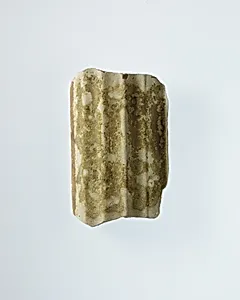
Vase fragment ?
Unknown Artist
ca. 1981–1640 B.C.
Medium
Faience, green glaze
Dimensions
H. 6.4 cm (2 1/2 in.); W. 3.8 cm (1 1/2 in.)
Classification
Vase fragment (?), fluted
Period
Middle Kingdom
Department
Egyptian Art
Museum
Metropolitan Museum of Art, New York, NY
Credit
Museum Accession
Accession Number
X.632.1
Rights
Public Domain
Art Historical Context
This delicate vase fragment, dating to Egypt's Middle Kingdom (ca 1981–1640 B.C.) during Dynasties 12–13, offers a glimpse into the refined artistry of ancient Egyptian craftsmen. Measuring just 6.4 cm high and 3.8 cm wide, this small piece from the Metropolitan Museum of Art's Egyptian Art collection likely once formed part of a graceful vessel, evoking the everyday elegance of elite households or temple offerings. Crafted from faience—a composite material of crushed quartz or sand coated in a vibrant green glaze—the exemplifies a prized Egyptian technique. Faience mimicked the luster of rare semi-precious stones like turquoise or malachite, making luxury accessible. The glossy green surface, achieved through copper-based pigments fired at high temperatures, not only enhanced durability but also symbolized fertility, rebirth, and the Nile's life-giving waters, tying the object to profound cultural beliefs. Though incomplete, this artifact highlights the Middle Kingdom's artistic revival after the Old Kingdom's grandeur. It reflects a period of stability and innovation, where faience production flourished for practical and ritual items, underscoring Egypt's mastery of color, form, and symbolism in miniature scale. A testament to enduring craftsmanship!