
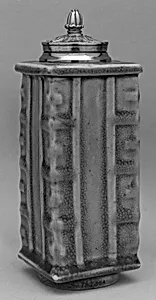
Vase in the form of a Neolithic ritual object cong
Unknown Artist
19th century
Medium
Porcelain with turqoise blue glaze (Jingdezhen ware), gilt bronze cover
Dimensions
H. 5 1/2 in. (14 cm); W. 2 1/8 in. (5.4 cm); L. 2 1/8 in. (5.4 cm)
Classification
Ceramics
Culture & Period
China · Qing dynasty (1644–1911)
Department
Asian Art
Museum
Metropolitan Museum of Art, New York, NY
Credit
Purchase by subscription, 1879
Accession Number
79.2.95a, b
Rights
Public Domain
Art Historical Context
This exquisite porcelain vase, crafted in 19th-century China during the Qing dynasty (1644–1911), takes the distinctive form of a Neolithic *cong*—an ancient ritual object dating back over 5,000 years. Shaped as a square tube with rounded corners, the *cong* was a sacred jade artifact used in early Chinese shamanistic ceremonies, symbolizing the union of heaven and earth. Here, artisans at Jingdezhen—the renowned imperial porcelain capital—masterfully reinterpreted this prehistoric form in delicate ceramics, standing just 5½ inches tall. The vase's turquoise blue glaze evokes the vibrant hues of ancient jades, while its gilt bronze cover adds a luxurious Qing-era flourish, blending reverence for antiquity with opulent craftsmanship. Jingdezhen wares were celebrated for their fine kaolin clay and cobalt glazes, fired at high temperatures to achieve translucency and depth. This piece reflects the Qing fascination with archaism, where scholars and emperors collected and emulated Neolithic treasures to connect with China's venerable past. Acquired by subscription in 1879 for the Metropolitan Museum of Art's Asian Art collection, this vase invites us to ponder the enduring cultural dialogue between eras—how a ritual relic from prehistory was reborn as a collector's gem in the twilight of imperial China.