
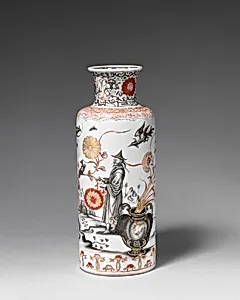
Vase (one of a pair)
early 18th century, decoration ca. 1729–32
Medium
Hard-paste porcelain (Jingdezhen ware)
Dimensions
Each, H. 10 11/16 in. (27.1 cm.); Diam. 4 1/8 in. (10.5 cm.)
Classification
Ceramics-Porcelain-Export
Culture
Chinese with Bohemian, Kronstadt decoration
Department
European Sculpture and Decorative Arts
Museum
Metropolitan Museum of Art, New York, NY
Credit
Gift of R. Thornton Wilson, in memory of Florence Ellsworth Wilson, 1954
Accession Number
54.147.97
Rights
Public Domain
Tags
Art Historical Context
This elegant vase, one of a matching pair, exemplifies the global exchange of artistry in the early 18th century Crafted from high-quality hard-paste porcelain Jingdezhen, China's imperial kilns, the vase body dates to the early 1700s. These blank "blanks" were exported to, where they were transformed through local decoration—a common practice that blended Eastern craftsmanship with Western imagination. Around 1729–32, Bohemian artist Ignaz Preissler adorned it in the Kronstadt workshops with vibrant chinoiserie scenes featuring birds, men, and flowers. Chinoiserie, a fanciful European take on Chinese motifs, captured the Rococo era's love for exoticism, using enamel colors fired at low temperatures to create vivid, detailed narratives. Preissler's skilled handiwork highlights the technical prowess of overglaze painting on durable porcelain. Standing at 10⅝ inches tall, this piece reflects the luxury trade that fueled Europe's obsession with porcelain, often called "white gold." Donated to The Metropolitan Museum of Art in 1954, it invites us to appreciate how cultural fusion shaped decorative arts, bridging continents through beauty and innovation.
About the Artist
Ignaz Preissler · 1676–1741
German, Friedrichswald 1676–1741Kronsstadt