
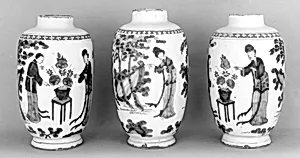
Vase (part of a garniture)
Medium
Tin-glazed earthenware
Dimensions
Height: 7 in. (17.8 cm)
Classification
Ceramics-Pottery
Culture
Dutch, Delft
Department
European Sculpture and Decorative Arts
Museum
Metropolitan Museum of Art, New York, NY
Credit
Gift of Henry G. Marquand, 1894
Accession Number
94.4.337
Rights
Public Domain
Tags
Art Historical Context
Welcome to the European Sculpture and Decorative Arts gallery at the Metropolitan Museum of Art, where charming vase from the De Witte Starre Manactory in Delft, Netherlands, shines as a gem of 18th-century ceramics. Produced between 1723 and 1741 and attributed to painter Cornelison Jansonwer, it stands just 7 inches tall, crafted from tin-glazed earthenware—a hallmark of Delftware. This technique involved coating earthenware with tin oxide for a smooth, opaque white surface ideal for vibrant painted designs, mimicking luxurious Chinese porcelain at a more accessible price. As part of a *garniture*—a matched set of vases typically displayed on mantels or cabinets for symmetrical grandeur—this piece exemplifies Dutch ingenuity during the Golden Age's afterglow. Its decorations feature lively human figures amid blooming flowers, showcasing Brouwer's skill in polychrome enameling, where colors like blues, greens, and golds were layered and fired for lasting brilliance. Delft factories like De Witte Starre (The White Star) thrived on such export wares, blending local motifs with exotic influences to grace bourgeois homes across Europe. Gifted to the Met in 1894 by Henry G. Marquand, this vase invites us to appreciate the artistry of everyday luxury, bridging trade, craftsmanship, and domestic elegance in the Dutch Republic.