
Medium
glasswares
Classification
glasswares
Department
Smithsonian Collection
Museum
Smithsonian American Art Museum
Credit
Gift of Thomas Carnase
Accession Number
1983-60-1
Rights
Public Domain
About this artwork
Research in Progress
Art Historical Context
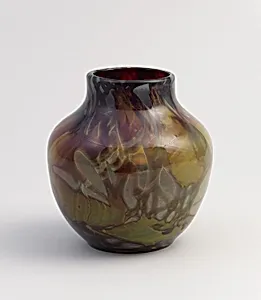
Louis Comfort Tiffany’s 1913 vase stands as a luminous example of American innovation in decorative glass. Born in 1848, Tiffany became renowned for transforming glass from a utilitarian material into an art form, drawing on the organic curves and luminous color of the Art Nouveau movement. Working at the height of his career, he led a dedicated team of glassmakers who experimented with new formulas and finishing techniques to achieve surfaces that shimmer like oil on water. This particular vase, now part of the Smithsonian American Art Museum’s collection, reflects Tiffany’s signature Favrile glass process, in which metallic oxides were introduced during blowing to create an iridescent sheen. Created just before World War I, the piece captures a moment when American designers were asserting independence from European traditions while embracing nature-inspired motifs. Its elegant shape and subtle color shifts invite viewers to appreciate both the technical mastery and the quiet poetry of handcrafted glass. Gifted to the museum by Thomas Carnase, the vase continues to demonstrate Tiffany’s lasting influence on twentieth-century design. Though research on this specific object remains ongoing, it embodies the era’s optimism about art’s ability to elevate everyday life through beauty and craftsmanship.