
Vase with cover
1769–80
Medium
Porphyry ware
Dimensions
Height: 7 5/8 in. (19.4 cm)
Classification
Ceramics-Pottery
Culture
British, Etruria, Staffordshire
Department
European Sculpture and Decorative Arts
Museum
Metropolitan Museum of Art, New York, NY
Credit
Rogers Fund, 1909
Accession Number
09.194.30a, b
Rights
Public Domain
Art Historical Context
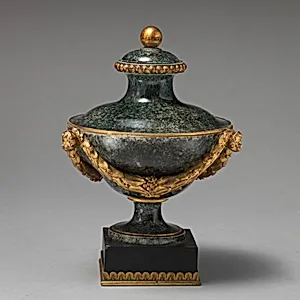
This elegant "Vase with Cover" from Wedgwood and Bentley crafted between 1769 and 1780, exemplifies the pinnacle of 18th-century British ceramics. Produced at Josiah Wedgwood's Etruria factory in Staffordshire,, it belongs to the firm's celebrated Porphyry ware—a luxurious stoneware that mimicked the prized ancient stone porphyry, known for its rich purple hue and sparkling flecks. Using finely ground red and white clays, Wedgwood achieved a marbled, gem-like surface through pioneering techniques like pressure-molding and slow bisque firing, revolutionizing mass-produced luxury goods. Historically, this vase reflects the Neoclassical fervor of the era, inspired by Etruscan and Roman antiquities unearthed in Italy. Wedgwood and his partner Thomas Bentley drew from classical motifs to appeal to enlightened elites, blending artistry with industrial precision. Standing at just 7 5/8 inches tall, its covered form suggests use as a scent jar or ornamental piece, embodying the era's fascination with revived ancient elegance. Acquired through the Rogers Fund in 1909 for the Metropolitan Museum of Art's European Sculpture and Decorative Arts collection, this vase highlights Wedgwood's role in elevating pottery to fine art status. Visitors will appreciate its tactile beauty—a testament to British ingenuity during the Industrial Revolution.