
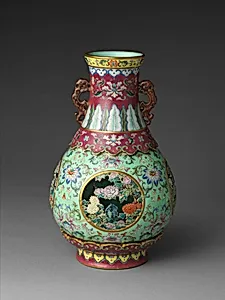
Vase with openwork ornaments
Unknown Artist
mid-18th century
Medium
Porcelain painted in overglaze polychrome enamels, engraved ornaments, and gilt (Jingdezhen ware)
Dimensions
H. 11 3/4 in. (29.8 cm); Diam. 7 1/2 in. (19.1 cm); Diam. of rim 3 3/8 in. (8.6 cm); Diam. of foot 4 1/4 in. (10.8 cm)
Classification
Ceramics
Culture & Period
China · Qing dynasty (1644–1911), Qianlong period (1736–95)
Department
Asian Art
Museum
Metropolitan Museum of Art, New York, NY
Credit
Purchase by subscription, 1879
Accession Number
79.2.658
Rights
Public Domain
Tags
Art Historical Context
This elegant "Vase with Openwork Ornaments," crafted in mid-18th-century Jingdezhen porcelain during the Qianlong period (1736–95) of China's Qing dynasty (1644–1911), the era's unmatched technical virtuosity and imperial refinement. Standing 11¾ inches tall with a slender neck and flared foot, the vase features pierced openwork designs—delicate cutouts that allow light to filter through, creating a luminous, sculptural effect. Vibrant overglaze polychrome enamels, applied after the initial high-fired glaze and then low-fired for color stability, bring floral motifs to life, while gilding adds a touch of opulent shimmer. Jingdezhen, the epicenter of porcelain production for centuries, supplied the imperial court and global markets, with Qianlong-era wares prized for their innovation and precision. The combination of engraved openwork, enamel painting, and gold detailing demanded extraordinary skill, pushing the boundaries of ceramic engineering while evoking natural grace through flower imagery symbolizing prosperity and harmony in Chinese culture. Acquired by the Metropolitan Museum of Art in 1879 via public subscription, this vase reflects the 19th-century Western fascination with Chinese export porcelain, bridging East and West in a timeless display of artistry. Visitors will appreciate its fragility and finesse up close in the Asian Art galleries.