
Vase with owl heads and "cloisonné" decoration
1868
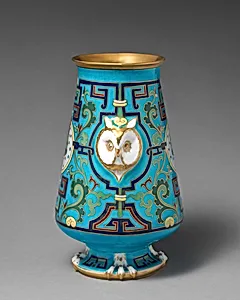
Medium
Bone china
Dimensions
confimred: 7 9/16 × 4 11/16 × 4 5/8 in., 1.4 lb. (19.2 × 11.9 × 11.7 cm, 650g)
Classification
Ceramics-Porcelain
Culture
British, Stoke-on-Trent, Staffordshire
Department
European Sculpture and Decorative Arts
Museum
Metropolitan Museum of Art, New York, NY
Credit
Gift of Helene Fortunoff and Robert Grossman, 2017
Accession Number
2018.62.14
Rights
Public Domain
Art Historical Context
This exquisite bone china vase, crafted by renowned Minton pottery firm in Stoke-on-Trent Staffordshire, in 186, captures the pinnacle of Victorian ceramic innovation. Measuring just over 7 inches tall, its compact form belies the technical mastery of British porcelain production during the Industrial Revolution. Bone china, a translucent and durable medium pioneered in England, allowed Mintons—leaders in the Staffordshire Potteries—to rival the finest Oriental wares, blending strength with delicate elegance. The vase's whimsical design features owl heads, symbols of wisdom beloved in Victorian decorative arts, paired with "cloisonné" decoration—a clever imitation of the intricate cloisonné enameling technique traditionally used on metal. This faux-cloisonné effect, achieved through precise overglaze painting and gilding, reflects the era's fascination with Eastern aesthetics amid growing global trade and Japonisme influences. Mintons excelled in such experimental finishes, elevating everyday objects into luxurious statement pieces for affluent homes. Housed in the Metropolitan Museum of Art's European Sculpture and Decorative Arts department as a 2017 gift, this vase exemplifies how 19th-century British potters transformed ceramics from utilitarian craft to high art, bridging functionality and fantasy in the heart of England's pottery capital.
About the Artist
Minton(s) · 1793–2001
Minton is among the most distinguished names in the history of British ceramics, a firm whose two and a quarter centuries of production encompass everything from blue transfer-printed earthenwares to the most rarefied decorative porcelain of the Victorian age. The company was founded in 1793 by Thomas Minton (1765–1836) in Stoke-upon-Trent, Staffordshire — the heart of England's pottery industry. ...