
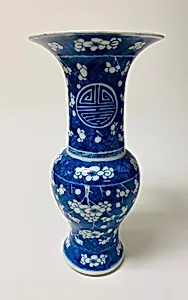
Vase with plum blossoms (one of a pair)
Unknown Artist
late 17th–early 18th century
Medium
Porcelain painted in underglaze cobalt blue (Jingdezhen ware)
Dimensions
H. 18 1/4 in. (46.4 cm); Diam. 7 in. (17.8 cm)
Classification
Ceramics
Culture & Period
China · Qing dynasty (1644–1911), Kangxi period (1662–1722)
Department
Asian Art
Museum
Metropolitan Museum of Art, New York, NY
Credit
H. O. Havemeyer Collection, Bequest of Mrs. H. O. Havemeyer, 1929
Accession Number
29.100.306
Rights
Public Domain
Art Historical Context
This elegant vase, one of a pair adorned with delicate plum blossoms, hails from China's Jingdezhen kilns during the Kangxi period (1662–1722) of the Qing dynasty Standing at 18¼ inches tall, it exemplifies the era's mastery of porcelain production, a craft that reached new heights under Emperor Kangxi's patronage. Jingdezhen the porcelain capital, supplied imperial courts and exported wares worldwide, blending technical innovation with artistic refinement. Crafted from fine white porcelain and painted in underglaze cobalt blue—a technique where cobalt pigment is applied before glazing and fired at high temperatures—this vase showcases vibrant, durable designs that resist fading. The cobalt, imported from Persia, yields the signature intense blue that defined blue-and-white porcelain, a style beloved for its clarity and depth. Plum blossoms, sparsely branched against a subtle ground, evoke the Kangxi aesthetic of elegant simplicity. In Chinese culture, plum blossoms symbolize resilience and renewal, blooming defiantly in winter's chill—a poetic nod to endurance cherished by literati scholars. Part of the renowned H. O. Havemeyer Collection and now at The Metropolitan Museum of Art, this vase invites visitors to appreciate the Qing dynasty's global influence on ceramics, where beauty met imperial ambition.