
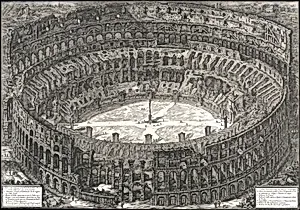
Veduta dell'Anfiteatro Flavio detto il Colosseo, from: 'Vedute di Roma' (Views of Rome)
Giovanni Battista Piranesi, 1776
About this artwork
Step into the majestic ruins of ancient Rome with Giovanni Battista Piranesi's *Veduta dellfiteatro Flavio il Colosseo* (View of the Flavian Amphitheater Known as the Colosseum an etching from his renowned series *Vedute di* (Views of Rome created in 1776. This monumental print, measuring an impressive 30 x inches, captures the Colosseum's weathered arches and towering form against a vast sky, evoking the of imperial grandeur amid decay. Piranesi, a masterful Venetian-born artist and architect active in 18th-century Rome, was obsessed with antiquity, producing over 100 vedute that romanticized the Eternal City's landmarks for Grand Tour travelers and scholars. Piranesi's etching technique shines here, with intricate lines and deep blacks creating dramatic contrasts of light and shadow that amplify the structure's scale and texture. Part of the Prints, Ornament & Architecture classification in the Metropolitan Museum of Art's Drawings and Prints department—acquired through The Elisha Whittelsey Collection—this work exemplifies his vedutismo style, blending precise topography with imaginative flair to convey Rome's layered history from Flavian emperors to Baroque Rome. Today, it reminds us of the Colosseum's legacy as the world's largest amphitheater, site of gladiatorial spectacles for 50,000 spectators. Piranesi's vision not only preserved these wonders on paper but inspired generations to marvel at humanity's enduring architectural triumphs.