
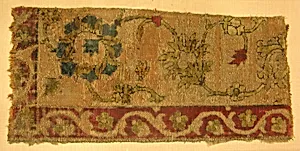
Velvet Fragment with Scrolling Floral Vine Design
Unknown Artist
16th century
Medium
Silk, metal wrapped thread; cut and voided velvet, brocaded
Dimensions
Textile: H. 11 3/8 in. (28.9 cm) W. 5 1/4 in. (13.3 cm) Mount: H. 16 3/16 in. (41.1 cm) W. 10 3/8 in. (26.4 cm)
Classification
Textiles
Department
Islamic Art
Museum
Metropolitan Museum of Art, New York, NY
Credit
Purchase, Mr. and Mrs. Jerome A. Straka and Margaret Mushekian Gifts, 1974
Accession Number
1974.272.1
Rights
Public Domain
Tags
Art Historical Context
This exquisite 16th-century velvet fragment, featuring a scrolling floral vine design, hails from the Islamic world, where such luxurious textiles adorned elite garments, furnishings, and ceremonial objects. Crafted from silk with metal-wrapped threads, its vibrant patterns evoke the lush gardens of paradise—a recurring motif in Islamic art symbolizing abundance and divine beauty. Though the artist remains unknown, the piece exemplifies the technical mastery of Ottoman or Safavid weavers, who produced opulent fabrics for courts and mosques. The medium employs sophisticated techniques: cut and voided velvet, where the pile is sheared away to reveal intricate patterns, combined with brocading—supplementary wefts woven to create raised, shimmering motifs. The metallic threads catch the light, enhancing the fabric's jewel-like quality and underscoring its role as a status symbol among the wealthy. Measuring just 11⅜ by 5¼ inches, this fragment preserves a glimpse of Renaissance-era Islamic luxury, now housed in the Metropolitan Museum of Art's Islamic Art department. It invites visitors to appreciate how floral vines intertwined art, nature, and spirituality in a golden age of textile innovation.