
Venus and Adonis
probably mid-1630s
Medium
Oil on canvas
Dimensions
With added strips, 77 3/4 x 95 5/8 in. (197.5 x 242.9 cm)
Classification
Paintings
Department
European Paintings
Museum
Metropolitan Museum of Art, New York, NY
Credit
Gift of Harry Payne Bingham, 1937
Accession Number
37.162
Rights
Public Domain
Tags
Art Historical Context
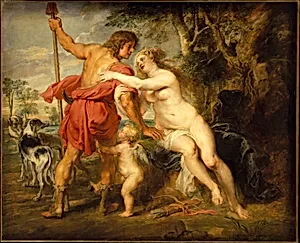
Peter Paul Rubens, the preeminent Flemish Baroque master, captures the mythic drama of *Venus and Adonis* this grand oil on canvas from the mid-1630s. Drawing from Ovid's *Metoses*, the painting depicts the goddess Venus desperately clutching her lover Adonis, urging him not to hunt amid looming danger, with the cherubic Cupid asleep nearby and faithful hounds at their feet. Rubens' sensual female nudes and dynamic figures embody the Baroque era's emphasis on movement, emotion, and the exuberant beauty of the human form, reflecting his role as a court painter blending classical mythology with Counter-Reformation vitality. The artwork's monumental scale—nearly 8 by 8 feet, even with later added strips—immerses viewers in its theatrical energy, achieved through Rubens' virtuoso brushwork: swirling drapery, glowing flesh tones, and luminous highlights that mimic natural light. Produced late in his career, it exemplifies his workshop's productivity and enduring fascination with this theme, which he revisited multiple times. Today, this masterpiece graces the Metropolitan Museum of Art, a 1937 gift that highlights its cultural prestige as a pinnacle of European painting.
About the Artist
Peter Paul Rubens · 1577–1640
Peter Paul Rubens (1577-1640) stands as the most influential artist of the Flemish Baroque tradition and the greatest exponent of Baroque painting's dynamism, vitality, and sensuous exuberance. Born in Siegen, Westphalia, and raised in Antwerp, Rubens received a humanist education studying Latin and classical literature before pursuing artistic training under three masters: Tobias Verhaecht, Adam ...