
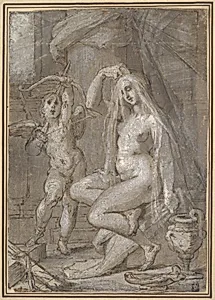
Venus and Amor
Bartholomeus Spranger, ca. 1585
About this artwork
In the late 16th century, Flemish artist Bartholomeus Spranger crafted this exquisite drawing *Venus and Amor* around 1585, capturing the timeless myth of Venus, goddess of love, with her son Cupid (also known as Amor). Spranger, a master of Northern Mannerism, served as court painter to Holy Roman Emperor Rudolf II in Prague, where he produced elegant, sensual figures that blended Italian Renaissance influences with elongated, graceful forms. This intimate scene exemplifies his style, emphasizing beauty, eroticism, and divine harmony through the tender embrace of mother and child. Executed in pen and brown ink with layered light and dark brown and gray washes, heightened with white gouache (now partially oxidized), the sheet measures a compact 7 5/8 x 5 5/16 inches. The "traced for transfer" technique reveals its preparatory purpose—likely a detailed study or cartoon for a larger painting, print, or fresco—highlighting the meticulous planning behind Mannerist works. Such mixed-media drawings were prized for their luminosity and sculptural depth, achieved through strategic highlights that mimic the play of light on flesh. Housed in the Robert Lehman Collection at The Metropolitan Museum of Art since 1975, this drawing offers a window into Spranger's innovative draftsmanship and the cultural fascination with classical mythology during the Renaissance. Visitors will appreciate its delicate virtuosity, a testament to an era when art celebrated the divine allure of the human form.